Por agora esta história só está disponível em inglês.
Uganda has long been defined, in the minds of many travelers, by a single, profound encounter: the moment a silverback mountain gorilla locks eyes with you in the misty forests of Bwindi Impenetrable National Park. This is, undeniably, a transformative experience. However, to reduce Uganda's safari potential to gorilla trekking alone is to overlook one of Africa's most geographically and ecologically varied destinations. From the thunderous roar of the Nile squeezing through a seven-meter gorge to the silent, tree-climbing lions of the southern savannah, Uganda offers a safari circuit that rivals any on the continent for sheer diversity. This article explores the experiences that lie beyond the gorillas, revealing a country where savannah, wetland, forest, and culture converge.
The Mighty Nile and the Savanna of Murchison Falls
In the northwest of Uganda, the Victoria Nile explodes through a narrow rocky gap, plunging roughly 43 meters with a force that can be heard and felt long before it is seen . Murchison Falls National Park, Uganda's largest conservation area at approximately 3,893 square kilometers, is centered on this dramatic spectacle . But the park is far more than a geological curiosity.https://elysonadventures.com/tours/10-days-wildlife-gorillas-and-chimps-trekking-safari
A boat cruise along the Nile toward the base of the falls is arguably the park's signature experience. This stretch of river is home to substantial populations of Nile crocodiles and hippopotamuses, alongside an array of waterbirds including the sought-after shoebill stork and Goliath heron . On the riverbanks, elephants, buffalo, and giraffes are frequently spotted . For those seeking a broader perspective, game drives across the northern savanna—characterized by borassus palms and acacia woodland—offer opportunities to see lions, leopards, and a wealth of plains species. Notably, of the classic Big Five, only rhinoceros is absent from the park itself, though the nearby Ziwa Rhino Sanctuary provides a crucial haven for reintroduced rhinos . Murchison Falls is often treated as an add-on to a western Uganda itinerary, but it stands firmly on its own as a complete safari destination .
Queen Elizabeth National Park: Tree-Climbing Lions and the Kazinga Channel
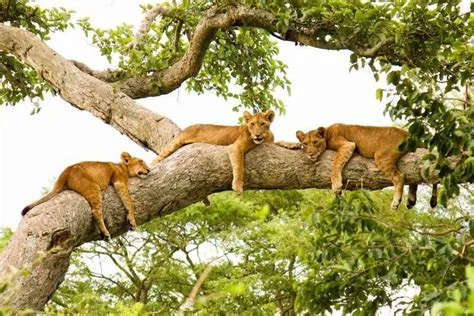
In the west, Queen Elizabeth National Park presents a different character entirely. The park is perhaps best known for its Ishasha sector, where lions have developed the unusual habit of lounging in the branches of fig trees during the heat of the day . This behavior, while not unique to Ishasha, is observed with remarkable consistency here, offering visitors a surreal photographic opportunity.
Beyond the lions, the park's Kazinga Channel—a natural waterway connecting Lake Edward and Lake George—supports one of the highest concentrations of hippos in Africa. Boat cruises along the channel provide close-up views of these massive animals, along with crocodiles and a profusion of birdlife . For those interested in primates, the Kyambura Gorge offers chimpanzee tracking in a dramatic sunken forest, while the Maramagambo Forest is ideal for guided nature walks . With nearly a hundred mammal species and over 600 bird species recorded, Queen Elizabeth is a microcosm of Uganda's broader ecological wealth .
Kibale Forest: The Primate Capital
While gorillas draw the headlines, Kibale Forest National Park is the undisputed primate capital of East Africa. The park harbors thirteen primate species, including one of the highest concentrations of chimpanzees in Uganda . Standard chimpanzee tracking involves a trek of two to four hours through well-maintained forest trails, culminating in an hour of observation as the chimps feed, socialize, and move through the canopy . For those seeking a deeper immersion, the Chimpanzee Habituation Experience allows visitors to spend an entire day with researchers, observing the troop from dawn until the chimps build their nests for the night .
Kibale's appeal extends beyond its famous apes. The surrounding landscape is dotted with volcanic crater lakes, and the "Top of the World" hike offers sweeping views over this distinctive terrain . The nearby Bigodi Wetland Sanctuary, a community-managed initiative, is a haven for birdwatchers seeking the great blue turaco and a model for how tourism can directly benefit local conservation efforts .
Lake Mburo: Safari on Foot, Bike, and Horseback
For travelers weary of the confines of a vehicle, Lake Mburo National Park offers something increasingly rare in African safaris: genuine mobility. Located just 228 kilometers from Kampala, Lake Mburo is the easiest national park to access from the capital, making it an ideal first or final stop on a Ugandan itinerary.
The park is deliberately devoid of elephants and is not a reliable destination for lions, a fact that allows for activities impossible in predator-dense reserves. Guided walking safaris with an armed ranger allow visitors to track zebras, giraffes, and antelopes on foot, reading the landscape in a way that is impossible from a vehicle. Mountain biking excursions outside the park boundaries offer intimate encounters with wildlife, while horse safaris provide a novel perspective—gliding silently among herds of zebra and impala that regard a mounted rider with curious tolerance rather than alarm. The park's network of lakes and wetlands also supports boat trips to see hippos and crocodiles, alongside birding for fish eagles and herons.
Kidepo Valley: Uganda's Secret Wilderness
For the most adventurous safari-goers, Kidepo Valley National Park in the far northeast is Uganda's most remote and, arguably, most rewarding destination. Gazetted in 1962, the park covers 1,442 square kilometers of semi-arid savanna, rocky outcrops, and palm-lined streams, bordered by mountains on the horizons of Kenya and South Sudan. It has only one luxury camp, and sightings of other vehicles are rare.
This isolation has preserved an astounding diversity of mammals—more than any other park in Uganda. Predators include lion, leopard, cheetah, and wild dog, while huge herds of buffalo sometimes number over a thousand individuals. The park is also one of the few places in East Africa where the patas monkey, a ground-dwelling primate with a distinctive moustache, can be seen. For birders, Kidepo is a paradise, with over 400 recorded species including the ostrich, kori bustard, and a host of raptors. Walking safaris from Apoka Safari Lodge allow visitors to explore this raw landscape on foot, accompanied by an experienced guide.
Jinja and the Nile: Adventure Beyond the Savannah
Not every safari experience needs to involve wildlife. Jinja, situated just over 80 kilometers east of Kampala at the source of the White Nile, has earned its reputation as East Africa's adventure capital. The stretch of river here, before it flows into Lake Kyoga, offers some of the world's most exhilarating white-water rafting and kayaking. For those seeking a more measured thrill, stand-up paddleboarding and gentle kayak cruises provide a different way to experience the river's power.
On land, quad biking excursions follow the Nile downstream toward Bujagali Falls, while horse riding combines riverside trails with village passages. The town itself holds historical and religious interest, with an active Hindu temple and a bronze bust of Gandhi marking his connection to the region. Jinja serves as a reminder that Uganda's appeal extends beyond its protected areas—the country's rivers, lakes, and towns offer their own distinct forms of exploration.
https://elysonadventures.com/tours/5-day-murchison-falls-safari-and-jinja-adventures
Cultural Immersion: Beyond the Wildlife
Throughout Uganda, cultural experiences provide context and connection that wildlife viewing alone cannot. Near Kibale, community tours in Bigodi village offer basket weaving demonstrations, traditional dance performances, and coffee-making lessons, directly supporting conservation through tourism revenue . In the Queen Elizabeth area, visitors can meet local women like Agartha, who shares her life story while demonstrating traditional food preparation, or Deo, a subsistence farmer who discusses the challenges and rewards of organic farming .
Closer to Kampala, the Ewaffe Cultural Village in Mukono District offers a day-long immersion in Buganda traditions. Visitors learn to prepare matooke and luwombo, wrapping ingredients in banana leaves for slow cooking over an open fire, and participate in traditional dances like Bakisimba and Nankasa . Elder storytellers share the wisdom of the Ssenga and Kojja, offering a glimpse into cultural values that have shaped the region for generations . These experiences are not mere add-ons; they are essential to understanding the human landscape in which Uganda's wildlife exists.
Conclusion
Uganda's safari identity is multifaceted. Murchison Falls offers the raw power of the Nile and classic savanna game viewing. Queen Elizabeth delivers tree-climbing lions and the extraordinary Kazinga Channel. Kibale satisfies primate lovers and birders alike. Lake Mburo redefines what a safari can be—on foot, on a bike, on horseback. Kidepo rewards those willing to travel far with solitude and wildlife density that few places can match. And Jinja, alongside the cultural villages scattered across the country, remind us that Uganda's story is as much about its people and landscapes as it is about its most famous primate. The gorillas are, rightly, a pilgrimage. But they are the beginning of Uganda's safari story, not its end.https://elysonadventures.com/
Planeie uma viagem a partir daqui
Diga-nos as suas datas e o que quer ver. Nós criamos a rota.