Dieser Beitrag ist vorerst nur auf Englisch verfügbar.
Before traveling to Uganda, understanding key health, safety, and entry requirements is essential for a smooth and unforgettable adventure. All visitors aged nine months and older must present a valid Yellow Fever vaccination certificate upon arrival, while malaria prophylaxis is strongly recommended year-round due to high-risk transmission zones. Passports require at least six months' validity and two blank pages. Most nationalities need a 50e−Visaorthe50e−Visaorthe100 East Africa Tourist Visa for multi-country travel.. Gorilla trekking in Bwindi and game drives in Murchison Falls remain safe with armed escorts. Pack neutral clothing, sturdy boots, and insect repellent. Register with your embassy and secure comprehensive travel insurance before departure.
1. Entry Requirements & Visas
Passport
- Must be valid for at least six months beyond your intended departure date
- Must have at least two blank pages for entry stamps (some sources recommend four pages)
Visa Options
Visa Type
Cost
Validity
Notes
Tourist Visa (e-Visa)
$50
90 days (single entry)
Most common; apply online 2–3 weeks before travel
East Africa Tourist Visa
$100
90 days (multiple entry)
Allows travel between Uganda, Rwanda, and Kenya
Visa on Arrival
$50 (cash)
90 days
Available at Entebbe Airport for most nationalities, but pre-arranged e-Visa recommended
Visa-free countries (as of 2025–2026): Nationals of 40 countries including Ireland, Malaysia, Singapore, UAE, Hong Kong, and most African nations no longer require a visa for stays up to 90 days. However, US, UK, and EU citizens still need a visa either via e-Visa or on arrival.
How to apply for e-Visa:
- Visit the official Uganda immigration website
- Complete online application
- Upload passport copy, passport photo, Yellow Fever certificate (sometimes required)
- Pay online
- Receive approval within 3–5 working days
- Print approval letter to present upon arrival
2. Health Requirements & Vaccinations
Mandatory: Yellow Fever Vaccination
- Required for all travellers aged 9 months and older regardless of country of origin
- Must be administered at least 10 days before arrival at an official Yellow Fever vaccination centre
- Must carry the International Certificate of Vaccination and Prophylaxis (the "yellow card") — physical copy, not digital
- Without it, you may be denied entry or forced to be vaccinated at the airport (with possible quarantine)
Strongly Recommended Vaccinations
Vaccine
Notes
Hepatitis A
Transmitted through contaminated food/water
Typhoid
Also, food/water borne
Tetanus
Boost every 10 years
Hepatitis B
For longer stays or potential medical exposure
Meningitis
Recommended for travel during dry season (Dec–Mar)
Rabies
For those planning extensive outdoor activities or working with animals
Cholera
For travellers visiting rural areas with limited water treatment
Malaria Prophylaxis (Essential)
- Malaria is present year-round in all areas below 2,000m (including Kampala, Entebbe, and most national parks)
- High-risk season: March–May and October–November (rainy seasons)
- Prophylaxis options (consult your doctor 6–8 weeks before travel):
- Atovaquone/proguanil (Malarone)
- Doxycycline
- Mefloquine (Lariam)
- Prevention measures:
- Use DEET-based insect repellent (30–50% DEET)
- Sleep under permethrin-treated mosquito nets
- Wear long sleeves and pants at dawn and dusk
- Consider treating clothing with permethrin
Other Health Considerations
- Altitude: Bwindi (1,160–2,607m) and Mgahinga (2,227–4,127m) — allow time to acclimatize
- Traveller’s diarrhea: Common; bring oral rehydration salts and consider prescription antibiotics (azithromycin)
- Schistosomiasis (Bilharzia): Avoid swimming in freshwater lakes (including Lake Bunyonyi and Lake Victoria) unless confirmed safe
- COVID-19: No longer required vaccinations or testing for most travellers, but check current regulations before travel
3. Safety & Security
Current Safety Assessment (as of 2026)
Authority
Rating
Details
Australian Government
Exercise high degree of caution
Due to terrorism and violent crime threats
UK Foreign Office
Advise against travel to some border areas
Within 50km of DRC border (including parts of Queen Elizabeth NP)
US State Department
Level 2: Exercise increased caution
Due to crime and terrorism
Specific Risk Areas
Kampala:
- Terrorist attacks have occurred in crowded areas (shopping malls, hotels, public transport hubs)
- Violent crime (armed robbery, carjacking, assault) increases after dark
- Use registered taxis or ride-hailing apps (Uber, Bolt), not unmarked street taxis
- Avoid walking alone at night anywhere in the city
Queen Elizabeth National Park:
- Ishasha sector (tree-climbing lions’ area) is within the 50km DRC border risk zone
- 2023 terrorist attack killed two foreign tourists near Katwe gate
- Security escorts and increased patrols now in place
- Most lodges and tour operators continue normal operations with armed escorts
- Consider flying rather than driving to this park.
Bwindi Impenetrable National Park:
- Remote location with limited infrastructure
- Security escorts provided for all gorilla trekking groups
- Armed rangers accompany treks
- Road travel from Queen Elizabeth to Bwindi passes through mountainous, sometimes remote areas
- Recommendation: Fly from Entebbe/Kampala to Bwindi airstrip (Kihihi or Kisoro) instead of driving 8–10 hours
Murchison Falls National Park:
- Generally considered safe with regular ranger patrols
- Avoid driving through Karuma region after dark (banditry risk)
DRC border areas (within 50km):
- Advised to reconsider non-essential travel
- Includes Virunga National Park area (closed to tourists as of 2024)
- Armed group activity, banditry, kidnapping risk
General Safety Tips
- Register with your embassy upon arrival in Uganda
- Purchase comprehensive travel insurance covering medical evacuation, trip cancellation, and adventure activities (gorilla trekking, chimpanzee tracking)
- Keep emergency numbers saved: Tourist Police (+256-414-320-000), your embassy
- Avoid political rallies, protests, or large gatherings — especially during election periods (most recent elections were peaceful for tourists in 2021 and 2026)
- Do not photograph military installations, police, government buildings, or airports
- Hide valuables (passport, cash, electronics) in hotel safes; leave expensive jewelry at home
- Use accommodation with 24/7 security — most mid-range and luxury lodges have guards and secure parking
4. Getting There & Getting Around
International Flights
- Entebbe International Airport (EBB) is the main gateway, located 40km from Kampala (approx. 1–2 hours drive depending on traffic)
- Major airlines: Ethiopian Airlines, Emirates, Qatar Airways, KLM, Brussels Airlines, Kenya Airways, RwandAir, Turkish Airlines
Domestic Flights (Recommended for remote parks)
Park
Airstrip
Flight Time from Entebbe
Cost (approx.)
Bwindi
Kisoro or Kihihi
1.5–2 hours
$250–$350 one-way
Murchison Falls
Pakuba or Chobe
1–1.5 hours
$200–$300 one-way
Queen Elizabeth
Mweya or Kasese
1–1.5 hours
$200–$300 one-way
Kidepo Valley
Kidepo
2–2.5 hours
$350–$450 one-way
Airlines: Aerolink Uganda, Bar Aviation, Jubba Airways (charter)
Road Travel
- Driving is on the left side of the road
- Road conditions vary greatly:
- Good: Kampala to Mbarara, Kampala to Jinja, Entebbe road
- Fair/poor: Sections of Masindi to Murchison Falls, Queen Elizabeth to Bwindi
- Rough/muddy: Within parks, Bwindi access roads, Ishasha sector roads
- 4x4 vehicle is strongly recommended for any safari, especially in wet season
- Night driving is discouraged (poor lighting, animals on road, banditry risk)
- Police roadblocks are common — always carry your passport, visa, and driving permit (International Driving Permit recommended)
- Self-driving is possible but not recommended for first-time visitors unfamiliar with local conditions, wildlife rules, and police interactions
5. Money, Costs & Tipping
Currency
- Ugandan Shilling (UGX) — use local currency for small purchases, tips, markets
- US Dollars (USD) — widely accepted for permits (gorilla/chimp), park fees, and at mid-range/luxury lodges
- Notes must be:
- Issued 2013 or later (older notes often refused)
- Clean, undamaged, without marks or tears
- Euros and GBP are accepted at some banks and hotels but less common
Costs (USD estimates, 2026 rates)
Item
Cost per person
Gorilla permit (foreign non-resident)
$800
Gorilla permit (foreign resident with work permit)
$700
Chimpanzee permit (Kibale)
$300
Chimpanzee permit (Budongo, Murchison area)
90–90–200
Park entry (Murchison Falls, Queen Elizabeth)
$45–$50 per day
Boat cruise (Murchison Falls)
$40
Budget accommodation (camping, basic bandas)
$20–$50 per night
Mid-range lodge
$100–250 per night
Luxury lodge
$300–$800+ per night
Car hire (4x4 with driver/guide, per day)
$180–$300
Domestic flight (one-way)
$200–$450
Tipping Guidelines
- Safari guide/driver: 15–25 per day (per group, not per person)
- Gorilla trekking ranger guide: 15–15–20 (trekking group tip)
- Porter (gorilla trekking): 10–10–15
- Hotel/lodge staff: 5–5–10 for bellhops, housekeeping
- Restaurant servers: 5–10% (if service charge not included)
ATMs & Credit Cards
- ATMs available in Kampala, Entebbe, Mbarara, Jinja, and Masindi — but rarely in national parks
- Visa is most widely accepted; Mastercard less common; Amex rarely accepted
- Carry cash (USD and UGX) for park fees, tips, small purchases, and emergencies
- Inform your bank of travel dates to avoid card blocks
6. Packing List
Essential Documents
- Passport (6+ months validity)
- Visa approval letter (if applying via e-Visa)
- Yellow Fever certificate (physical card)
- Travel insurance policy + emergency numbers
- Flight confirmations
- Accommodation and tour confirmations
- International Driving Permit (if self-driving)
Clothing
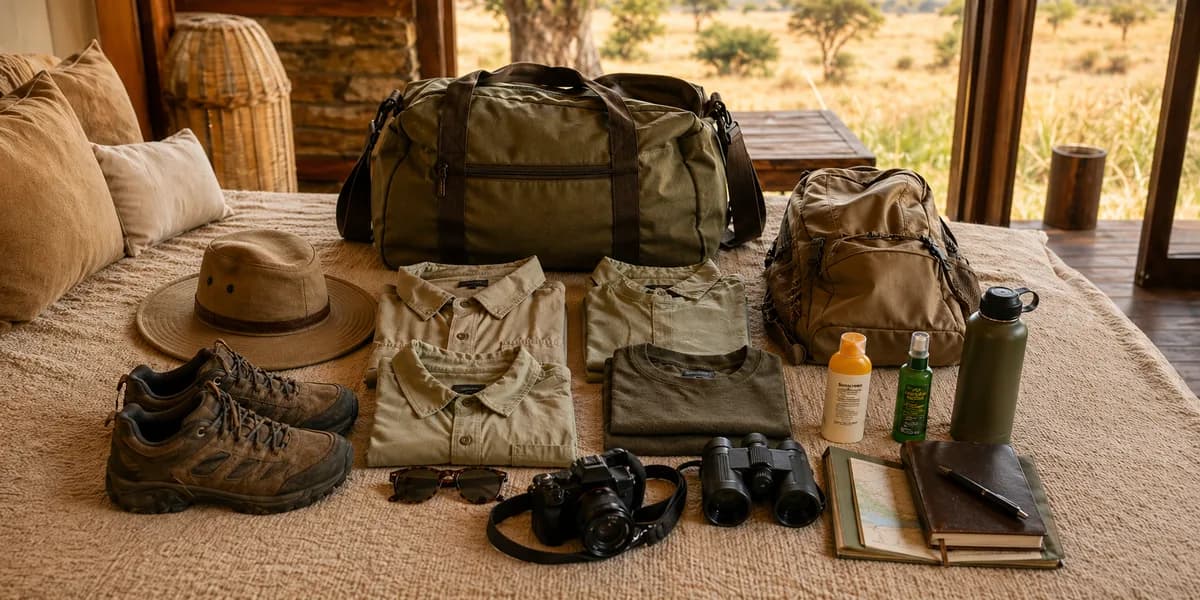
- Neutral colors (khaki, olive, tan, brown) — avoid white, bright colors, and camouflage (restricted)
- Long-sleeved shirts and long pants for sun and insect protection
- Lightweight, breathable fabrics (cotton, linen, quick-dry)
- Warm layers (fleece, light jacket) — early mornings and evenings can be chilly, especially in Bwindi (high altitude)
- Rain jacket or poncho — essential for gorilla trekking and wet season
- Swimsuit (lodges with pools, Lake Bunyonyi)
Footwear
- Sturdy, waterproof hiking boots (broken in before travel) — essential for gorilla and chimp trekking
- Gaiters (optional but highly recommended for mud and ants)
- Sandals or casual shoes for evenings and around lodges
Gear & Equipment
- Binoculars — essential for wildlife viewing
- Camera with telephoto lens (300mm or longer recommended) + extra batteries + memory cards
- Headlamp or flashlight (lodges may have power outages)
- Power bank and universal adapter (Uganda uses Type G, same as UK: 220–240V)
- Daypack for gorilla trekking (porter will carry your main bag; carry water, snacks, rain jacket)
- Reusable water bottle with filter (many lodges provide refill stations)
Health & Personal Care
- Insect repellent (DEET 30–50%)
- Sunscreen (SPF 30+)
- Lip balm with SPF
- Hand sanitizer
- Wet wipes
- Prescription medications (with copies of prescriptions, in original packaging)
- First aid kit (bandages, antiseptic, pain relievers, antihistamines, oral rehydration salts)
- Antimalarial medication (start before travel as directed)
- Motion sickness tablets (for boat cruises and winding mountain roads)
7. Culture & Etiquette
Greetings
- Handshake is standard, often accompanied by "How are you?" (Responses: "Fine, thank you" or "I am fine")
- Use right hand for handshakes, giving money, and eating — left hand is considered unclean
- Use titles (Mr., Mrs., Dr.) unless invited to use first names
Dress Codes
- Ugandans generally dress conservatively
- Kampala and towns: Avoid revealing clothing (short shorts, crop tops, low-cut tops)
- In rural areas and villages: Cover shoulders and knees out of respect
- At lodges and pools: Swimwear is fine, but cover up when not at the pool
Photography Etiquette
- Always ask permission before photographing people — a small tip (1,000–5,000 UGX ~ 0.30–0.30–1.50) is often appreciated
- Do not photograph military, police, government buildings, airports, or security checkpoints
- In parks, remain inside vehicle unless guided walks are permitted
Tipping & Gift Giving
- Tipping is expected for good service (see guidelines above)
- Do not give money or gifts directly to children — this encourages dependency and begging
- Instead, donate to reputable community projects, schools, or give through your lodge or guide
Language
- English is the official language and widely spoken in tourist areas
- Swahili is spoken in eastern and northern regions
- Luganda is common in central region (Kampala, Entebbe, Jinja)
- Learning a few words is appreciated: "Hello" (Oli otya in Luganda), "Thank you" (Webale or Mwebele), "Goodbye" (Weeraba)
8. Connectivity & Electricity
Internet & Mobile
- Mobile data is widely available through MTN, Airtel, and Africell
- SIM cards can be purchased at Entebbe Airport (MTN is most reliable for parks)
- Expect reliable 4G in Kampala, Entebbe, Jinja, Mbarara
- Limited to no signal in remote parks (Bwindi, Kidepo, parts of Murchison Falls)
- Wi-Fi is available at most mid-range and luxury lodges (speed varies, often slow)
Electricity
- Voltage: 220–240V
- Plug type: Type G (3 rectangular prongs, same as UK)
- Power outages are common — lodges often have generators or solar backup
- Bring a universal adapter and power bank
9. Weather & Best Time to Visit
Dry Seasons (Best for Safaris)
- December to February — warm, sunny, least rain
- June to August — cooler, dry, excellent for game viewing
- Wildlife viewing: Animals concentrate around water sources, roads passable
- Gorilla trekking: Trails firmer, easier hiking
Wet Seasons (Good for Birding & Budget Travel)
- March to May — heavy rains, especially April
- September to November — shorter rains, often afternoon showers
- Advantages: Lush scenery, fewer tourists, lower lodge rates, migratory birds arrive
- Disadvantages: Muddy roads, more challenging trekking, wildlife more dispersed
Temperature Ranges (by region)
Region
Daytime (°C / °F)
Night (°C / °F)
Notes
Kampala/Entebbe
24–28 / 75–82
15–20 / 59–68
Warm year-round
Murchison Falls
25–35 / 77–95
18–22 / 64–72
Hottest Park
Queen Elizabeth
22–30 / 72–86
15–20 / 59–68
Moderate
Bwindi (high altitude)
18–23 / 64–73
10–15 / 50–59
Cool, can be chilly
Lake Bunyonyi
20–25 / 68–77
8–12 / 46–54
Coldest nights
10. Prohibited Items & Customs
Prohibited imports (do not bring)
- Narcotics and illegal drugs (severe penalties, including imprisonment)
- Pornography
- Counterfeit goods
- Cultural artifacts or antiquities (export permit required)
- Henna
- Palm tree products
- Firearms without permit (pre-approval required, rarely granted for tourists)
- Political materials (including clothing with political slogans)
Restricted (limited quantities allowed duty-free)
- 200 cigarettes (or 100 cigars, or 500g tobacco)
- 1 liter of spirits
- 1 liter of wine
- 250ml perfume
- Reasonable amount of gifts for personal use
Currency Export
- You may take out up to the amount you declared upon arrival
- Declare amounts exceeding $10,000 USD (or equivalent) upon arrival
11. Emergency Contacts
Service
Phone Number
Tourist Police
+256-414-320-000
Ambulance
911 or 112
Police General
999
Entebbe Airport Police
+256-312-350-213
Uganda Wildlife Authority
+256-414-355-000
Embassy Contacts (Kampala)
Country
Phone
US Embassy
+256-414-306-001
UK High Commission
+256-312-312-000
Australian High Commission (Nairobi)
+254-20-427-7100
Canadian High Commission (Nairobi)
+254-20-366-3000
EU Delegation
+256-414-701-000
Final Summary Checklist
Before you go:
- Passport valid 6+ months, blank pages
- Visa obtained (e-Visa or confirm visa-free status)
- Yellow Fever vaccine (10+ days before travel, card packed)
- Other recommended vaccines (Hepatitis A, Typhoid, Tetanus)
- Malaria prophylaxis (started as prescribed)
- Travel insurance with medical evacuation
- Flight and accommodation confirmations
- Cash in USD (new notes, clean) and plan for UGX
- Photocopies of all documents (store separately from originals)
- Check embassy travel advisories
- Notify bank of travel dates
Upon arrival:
- Present Yellow Fever certificate (mandatory)
- Have visa approval letter ready (if e-Visa)
- Register with your embassy
- Purchase local SIM card at airport (optional)
During your stay:
- Use insect repellent and mosquito nets
- Drink only bottled or treated water
- Follow National Park rules and guide instructions
- Avoid political gatherings and demonstrations
- Do not photograph military or government buildings
- Tip guides and porters appropriately
- Keep valuables in hotel safe
Planen Sie eine Reise rund um dieses Thema
Nennen Sie uns Ihre Reisedaten und Wünsche. Wir stellen die Route zusammen.