Cet article n'est disponible qu'en anglais pour le moment.
Uganda offers an uncommon mix of landscapes, bringing together dense montane rainforests, vast wildlife reserves, and the roaring headwaters of Africa's longest river in a single journey. If you want a journey that delivers the country's most distinct highlights, three experiences stand above the rest: tracking mountain gorillas through the steep valleys of Bwindi Impenetrable National Park, following chimpanzee troops through the canopy of Kibale Forest, and navigating the churning whitewater of the Victoria Nile in Jinja. Each of these adventures provides an intimate, active look at the natural forces and wildlife that make Uganda one of the most rewarding safari destinations on the continent.
1. Face-to-Face with Mountain Gorillas in Bwindi Impenetrable Forest
Mountain gorilla trekking in Bwindi Impenetrable National Park is the central reason many international travellers make their way to East Africa. Bwindi encompasses 321 square kilometres of ancient, tangled montane and lowland forest along the edge of the Albertine Rift Valley in south-western Uganda. The park shelters roughly 459 mountain gorillas, which represents nearly half of the world's remaining wild population. Because these primates cannot survive in captivity, every encounter takes place on their terms, inside an unbroken habitat of bamboo thickets, giant ferns, and moss-draped hardwood trees that has survived continuously for over 25,000 years.
The Anatomy of the Trek
A day with the gorillas starts before sunrise. You gather at one of Bwindi's four park sectors—Buhoma, Ruhija, Rushaga, or Nkuringo—for a mandatory safety briefing at 08:00. Uganda Wildlife Authority (UWA) rangers organize visitors into small groups of no more than eight people per gorilla family. While you drink a morning coffee at the briefing point, advance trackers who entered the forest at dawn are already out on the trails, picking up the trail from where the gorilla family built their evening nests the night before.
Once your group departs, the hike can take anywhere from thirty minutes to upwards of four or five hours. There are no manicured paths. The rangers lead the way with machetes, carving a route through dense herbaceous vegetation, tangled roots, and damp volcanic soil. Bwindi's terrain is steep, ranging from 1,160 to 2,607 metres above sea level. You may cross narrow ravines, scale slippery muddy ridges, and push through stinging nettles. The physical demand varies every day depending on where the family has wandered in search of wild celery, bamboo shoots, and fruit.
The Sixty-Minute Encounter
When the trackers signal that the gorillas are just ahead, your ranger will instruct you to leave your trekking poles, daypacks, and food behind. Carrying only cameras, you approach quietly on foot. Slipping through the wild celery, you step directly into the world of the habituated family. A mature silverback may be resting against a buttress root, his deliberate gaze sweeping across the clearing, while blackbacks strip bark nearby and youngsters tumble through low branches.
The moment you see the gorillas, you forget about everything else.
Regulations require visitors to maintain a strict distance of at least seven metres from the primates to prevent the transmission of human respiratory pathogens, to which gorillas are highly vulnerable. For exactly sixty minutes, you sit quietly in the undergrowth watching them groom, feed, communicate with low grunts, and settle into mid-day naps. The time passes rapidly, yet the impression left by their calm presence and human-like eyes remains permanently etched in memory.
Permits, Costs, and Booking Realities
Because access is strictly managed to protect gorilla health and forest integrity, permit availability is tightly capped. Daily permits are limited to eight visitors per habituated family. As of 2026, a gorilla trekking permit costs US$800 per person for foreign non-residents. This revenue directly finances round-the-clock anti-poaching patrols, veterinary interventions by Gorilla Doctors, park infrastructure, and revenue-sharing schemes that support medical clinics and schools in neighbouring agricultural communities.
Permits sell out months ahead, particularly for the dry seasons running from June to September and December to February. To secure your preferred sector and avoid disjointed road transfers, it is critical to reserve your permits well in advance. For a deeper breakdown of planning considerations, consult our guide on Uganda gorilla trekking permit details.
Essential Gear for Bwindi
- Sturdy, waterproof hiking boots with deep tread to manage slick clay and steep inclines.
- Long trousers and long-sleeved shirts made from quick-drying synthetic fabrics to protect against thorns and nettles.
- Gardening gloves with rubberised grips, which allow you to grasp branches and vines securely without cuts or stings.
- Tall gaiters or thick socks to tuck your trouser legs into, preventing safari ants from crawling up your legs.
- A lightweight, waterproof rain jacket or poncho stored in a waterproof daypack, as rain falls unexpectedly throughout the year.
- At least two litres of drinking water and high-energy trail snacks to sustain you through hikes that can extend over several hours.
We strongly advise hiring a local porter at the park headquarters before heading out. For a modest fee, usually around US$20, a porter will carry your daypack, assist you over slippery logs, and steady your footing on steep ascents. This service provides direct household income to community members living along the park boundary.
2. Tracking Wild Chimpanzees in Kibale National Park
While Bwindi offers a quiet, grounded encounter with mountain gorillas, tracking chimpanzees in Kibale National Park provides an energetic, vocal expedition. Kibale covers 795 square kilometres in western Uganda, forming an ecological corridor with Queen Elizabeth National Park. It is widely recognised as the primate capital of East Africa, supporting roughly 1,500 chimpanzees alongside twelve other primate species, including red colobus monkeys, L'Hoest's monkeys, black-and-white colobus, and grey-cheeked mangabeys.
The Energy of the Canopy
Chimpanzee tracking begins from the Kanyanchu Visitor Centre with morning briefings at 08:00 or afternoon sessions at 14:00. Unlike mountain gorillas, who spend the majority of their time feeding peacefully on the forest floor, chimpanzees are highly arboreal, acrobatic, and constantly on the move. Tracking them requires listening carefully to the forest. Long before you spot them, you will hear their pant-hoots: rolling vocal calls that start as quiet grunts, build into screaming crescendos, and echo across the 351 tree species that make up Kibale's dense canopy.
The rangers follow these auditory signals, moving along established forest trails and cutting through secondary growth. When you intercept a troop, the experience is kinetic. You might find a large community fifty metres above you, gorging on ripe wild figs and flinging branches down, or you may encounter alpha males patrolling their territory along the forest floor at a rapid, purposeful pace. Treks typically run between two and four hours, and once found, visitors are allowed one hour of observation.
Social Complexity and Primate Behaviour
Spending an hour with wild chimpanzees reveals an intricate social system. You will observe grooming rituals that reinforce alliances between males, playful sparring matches among younger chimps, and mothers carrying infants on their bellies or backs. Chimpanzees share roughly 98.7% of human DNA, and their facial expressions, tool usage, and cooperative hunting strategies are readily apparent during close tracking. For a broader comparison of chimpanzee sites, read our breakdown of chimpanzee trekking across different reserves.
Bigodi Wetland Sanctuary: The Community Extension
A standard morning tracking chimpanzees in Kibale pairs naturally with an afternoon walking tour of the neighbouring Bigodi Wetland Sanctuary. Managed by the Kibale Association for Rural and Environmental Development (KAFRED), this community-run wetland encompasses a biodiversity corridor rich in birdlife and swamp primates. Elevated wooden boardwalks carry you through papyrus beds where you can easily spot the spectacular great blue turaco, alongside hornbills, kingfishers, and rare swamp-dwelling monkeys.
The Bigodi walk finishes in the village, where you can spend time learning how residents brew local beverages from bananas, roast organic coffee using traditional mortar and pestle techniques, and weave intricate baskets. All proceeds from the sanctuary walks flow back into community initiatives, funding local schools and community water supplies.
3. Running the Rapids of the Victoria Nile in Jinja
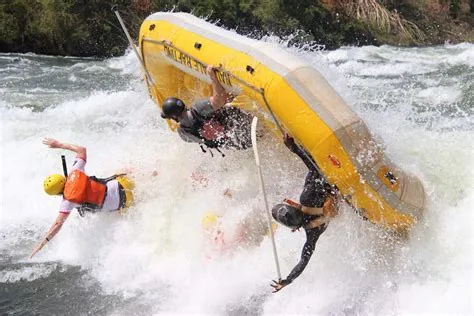
Contrasting with the forest tracking of western Uganda, the town of Jinja in the east provides one of the great river adventures of the world. Positioned at the historical source of the Nile, where Lake Victoria empties into the Victoria Nile, Jinja has earned its reputation as the adventure hub of East Africa. Running the rapids here is not a slow float down a peaceful river; it is a full-day, high-volume whitewater expedition on warm equatorial water.
The Power of the Upper Nile
What makes whitewater rafting in Jinja unique is the colossal volume of the Nile. Unlike technical alpine rivers that feature sharp rocks and tight channels, the Nile is a high-volume river characterised by deep channels, massive standing waves, and foaming hydraulics created by enormous currents surging over submerged islands and volcanic ledges. Because the river is warm year-round, falling out of the raft involves zero shock from icy temperatures.
Trips begin with an extensive safety briefing on calm water before the first rapid. River guides instruct paddlers on paddle commands, forward and reverse strokes, how to wedge your feet under inner safety tubes, and what to do if the raft flips. Experienced safety kayakers and dedicated motor-driven safety catamarans flank the rafting fleet throughout the day, carrying spare paddles, dry bags, first-aid gear, and cold drinking water.
Grade 3 versus Grade 5: Choosing Your Line
Travellers can choose the intensity of their descent based on their appetite for adventure. The river allows for two primary approaches:
- Grade 5 Full-Throttle Rafting: Designed for thrill-seekers who want to tackle the largest drop-offs, boiling cauldrons, and massive crests. Your guide will steer into the heart of iconic rapids such as 'Overtime' and 'The Bad Place', where flipping the boat is common and highly entertaining.
- Grade 3 Scenic Rafting: An ideal alternative for families, younger travellers, or those who prefer a less extreme descent. The guides take wider, bypass channels that hit rolling standing waves while avoiding turbulent hole features and vertical drops.
- Flatwater Sections: Between the dramatic drops lie calm, expansive stretches of the Nile where paddlers can jump in, float beside the boats, and watch open-billed storks, pied kingfishers, and fish eagles hunting along the lush riverbanks.
A typical rafting excursion covers roughly twenty kilometres of river, ending in the late afternoon with a riverside barbecue lunch of grilled meats, fresh pineapple, and cold drinks before returning to Jinja or Kampala.
How to Combine All Three Experiences in One Safari
Experiencing mountain gorillas, chimpanzees, and the whitewater of the Nile on a single safari requires a thoughtful route to minimise long road transfers and keep transit days comfortable. Uganda's transport network connects these distinct regions through a western circuit that loops back toward the central and eastern districts.
A standard sequence begins in Entebbe or Kampala, where you drive east to Jinja for a day of rafting and river exploration. From Jinja, you head west, breaking the road journey with wildlife stops such as tracking southern white rhinos on foot at Ziwa Sanctuary or viewing savannah wildlife and the dramatic waterfall at Murchison Falls National Park. From there, your vehicle heads south into the rolling tea plantations surrounding Kibale Forest for chimpanzee tracking.
After Kibale, continuing south brings you through the open plains of Queen Elizabeth National Park. This offers a rewarding savannah interlude, allowing you to take a boat cruise on the Kazinga Channel—home to thousands of hippos and basking Nile crocodiles—and search the fig trees of the Ishasha sector for tree-climbing lions before reaching the steep hills of Bwindi for your gorilla trek.
For travellers who want a thoroughly planned itinerary covering these highlights with professional guiding and private transport, our 9 Days Wildlife, Gorillas and Chimps Trekking Safari combines Uganda's premier primate forests and savannah parks into a seamless loop. If you wish to extend the journey across borders into Tanzania's Serengeti and Ngorongoro Crater, our extended 21 Days Tanzania Migration and Explore Uganda Safari provides the ultimate East African overland journey.
Practical Logistics and Travel Seasons
When scheduling your trip, consider Uganda's distinct rainfall cycles. The country experiences two primary dry seasons: from June through September and from December through February. These months deliver firmer hiking trails in Bwindi and Kibale, clearer skies for photography, and easier road conditions across rural sectors. However, because both Bwindi and Kibale are equatorial rainforests, short showers can fall at any time of year.
The shoulder and wetter months (March to May and October to November) bring higher rainfall, making the forest trails slicker and more demanding. On the other hand, the landscape during these months is vibrant green, lodges often feature lower seasonal rates, and the major parks have fewer safari vehicles. Whitewater rafting in Jinja operates consistently year-round regardless of season, as the outflow of Lake Victoria provides a steady, reliable volume of water.
Distances between destinations can be misleading on a map. While Uganda is geographically compact compared to its neighbours Kenya and Tanzania, mountainous terrain and winding dirt tracks mean travel speeds average forty to fifty kilometres per hour once you leave the tarmac arteries. Using a sturdy 4x4 safari vehicle equipped with heavy-duty suspension and driven by an experienced local guide is essential for keeping transfers smooth and safe.
Whether you want to climb through misty highland ridges toward a family of mountain gorillas, keep pace with chimpanzees calling through the Kibale canopy, or plunge into the warm crests of the Victoria Nile, a well-paced itinerary lets you enjoy all three bucket list adventures without unnecessary rush. Start planning your custom Uganda itinerary by reaching out to plan your safari with Elyson Adventures, and our team in Kampala will help craft a route matched to your timeframe and travel style.
Organisez un voyage autour de ce thème
Donnez-nous vos dates et vos envies. Nous construisons l'itinéraire.