Cet article n'est disponible qu'en anglais pour le moment.
Lions (Panthera leo) are Africa's most iconic big cats and the only truly social felines. Below is a detailed collection of facts specific to African lions—their populations, behaviour, habitats, and conservation.
Population and Distribution
Africa's wild lion population is estimated at roughly 20,000–25,000 individuals, a steep decline from an estimated 200,000 a century ago. Lions have vanished from more than 90% of their historic range and now occupy mainly protected areas in East and Southern Africa. The strongest populations are in Tanzania (Serengeti, Ruaha, Selous), Kenya (Maasai Mara), South Africa (Kruger), Botswana (Okavango, Chobe), Zimbabwe, Zambia, and Namibia. West and Central African lions are critically endangered and genetically distinct—the West African lion survives in only a handful of protected areas, with perhaps a few hundred individuals remaining (notably in Senegal's Niokolo-Koba and Benin's Pendjari/W-Arly complexes).
Subspecies and Genetics
African lions were traditionally treated as one subspecies, but genetic studies recognise two main groupings: the northern lion (including West and Central African populations, and the Asiatic lion) and the southern lion (East and Southern Africa). West African lions are smaller, with sparser manes, and are genetically distinct from their eastern and southern relatives. Notably, some East African lions—particularly in Uganda's Queen Elizabeth National Park—are famous for climbing trees, a behaviour rarely seen elsewhere.
Social Structure
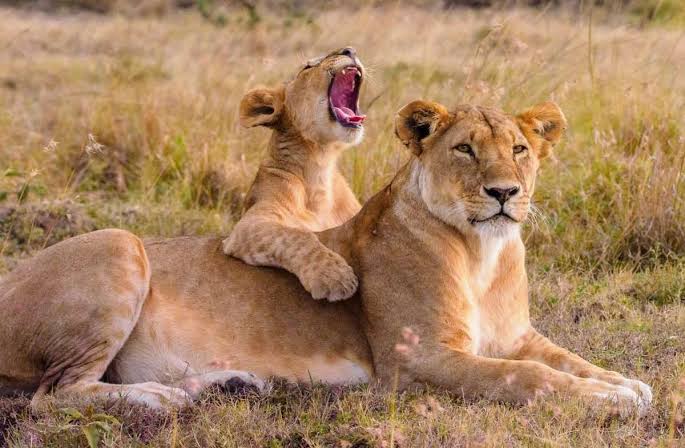
African lions live in prides of typically 3–15 related females, their cubs, and a coalition of 1–4 adult males. Females are the stable core; males hold territory temporarily and are displaced in violent takeovers, after which incoming males often kill existing cubs. Female lions often synchronise births, and cubs are raised communally—mothers may even nurse each other's young. Pride size and territory vary with prey density: Serengeti prides may number 20+, while lions in arid areas like the Kalahari live in smaller groups over vast ranges.
Hunting and Diet
African lions are apex predators and the only cats that hunt cooperatively in groups. Females do most of the hunting, targeting wildebeest, zebra, buffalo, antelope (impala, gazelle), and warthog; males often take over at the kill. Lions also scavenge and steal kills from hyenas, cheetahs, and leopards—and hyenas in turn steal from lions, fuelling a famous rivalry. A lion can sprint at about 80 km/h (50 mph) for short bursts. Adults need roughly 5–7 kg of meat per day and a large kill can feed a pride for days. Lions can survive long periods without water, obtaining moisture from prey and plants.
Reproduction and Cubs
Gestation lasts about 110 days, with litters of 1–4 cubs. Cubs are born blind and helpless, hidden for the first weeks. Mortality is high—up to half or more die in their first year from starvation, disease, and infanticide. Cubs are weaned around 6–7 months, and young males leave the pride at 2–3 years old to become nomads before attempting to take over a pride.
Behaviour and Communication
The African lion's roar can be heard up to 8 km (5 miles) away and serves to advertise territory and locate pride members. Lions also scent-mark, head-rub, and use facial expressions. They rest up to 20 hours a day and are most active at dawn, dusk, and night. Lions are strong swimmers and capable climbers—the tree-climbing lions of Queen Elizabeth National Park (Uganda) and Lake Manyara (Tanzania) are a celebrated exception to their usually ground-dwelling habits.
Physical Traits
Males weigh 150–250 kg (330–550 lb) and females 110–180 kg (240–400 lb). Only males have manes, whose size and darkness signal fitness and are influenced by testosterone, nutrition, and climate—manes tend to be fuller in cooler, wetter regions. Lions have retractable claws, a rough spiny tongue for scraping meat, and a reflective eye layer (tapetum lucidum) for night vision. They pant rather than sweat to regulate temperature.
Conservation Status
The IUCN lists the lion as Vulnerable, with the West African population Critically Endangered. Major threats include habitat loss and fragmentation, human–wildlife conflict (livestock depredation leading to retaliatory killing), prey depletion from bushmeat hunting, and poorly regulated trophy hunting. Key strongholds—Serengeti, Maasai Mara, Okavango, Kruger—anchor conservation efforts focused on protected-area management, community conservancies, conflict-mitigation tools (like improved bomas), and prey restoration.
Cultural and Economic Significance
Lions are symbols of power across Africa—appearing on flags, coats of arms, and currency—and are a flagship species for safari tourism, generating substantial revenue for conservation and local economies. They are also keystone predators whose presence indicates a healthy savanna ecosystem.
Quick Reference
| Fact | Detail |
|---|---|
| African population | ~20,000–25,000 |
| Social unit | Pride (3–15 females + cubs + 1–4 males) |
| Gestation | ~110 days |
| Top speed | ~80 km/h (short bursts) |
| Roar range | Up to 8 km |
| Daily rest | Up to 20 hours |
| IUCN status | Vulnerable (West African: Critically Endangered) |https://elysonadventures.com/tours?country=uganda
Organisez un voyage autour de ce thème
Donnez-nous vos dates et vos envies. Nous construisons l'itinéraire.